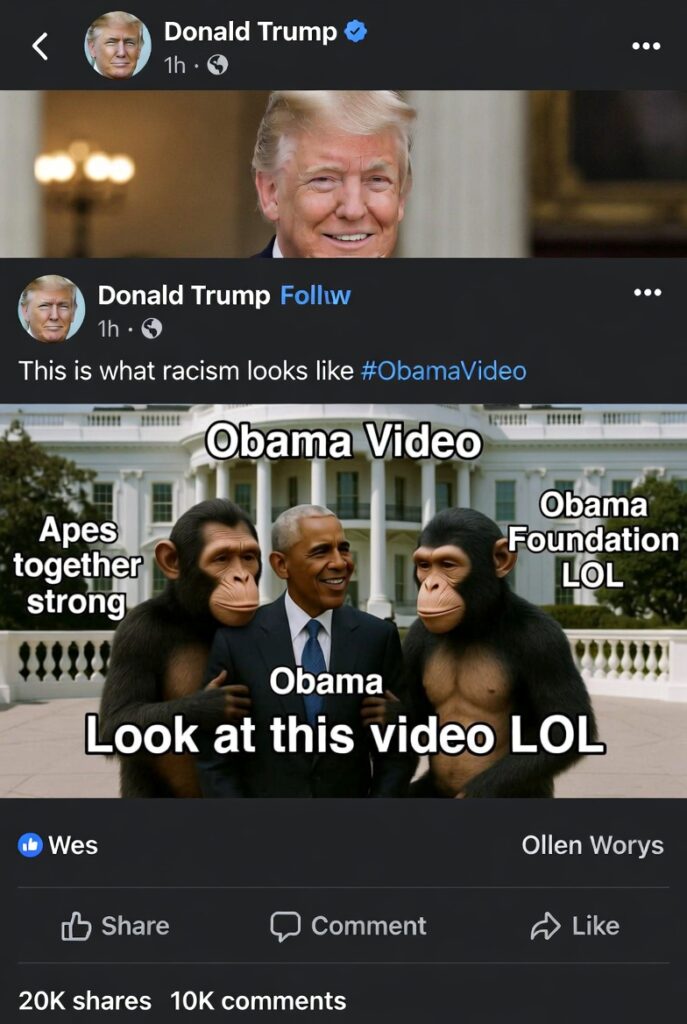
On February 5, 2026, just before midnight, U.S. President Donald Trump’s official Truth Social account posted a short video that ended with a brief, inflammatory clip: former President Barack Obama and former First Lady Michelle Obama depicted as laughing monkeys. The imagery draws on a long-standing racist trope that has historically been used to dehumanize Black people.
The roughly one-minute video primarily recycled false claims of 2020 election fraud before transitioning to a montage of prominent (mostly Democratic) political figures portrayed as jungle animals. It concluded with the Obamas as monkeys, while Trump was represented as a “lion king” figure — a recurring theme in some pro-Trump online memes.
The post triggered immediate bipartisan backlash. Several Republican lawmakers publicly condemned it:
- Sen. Tim Scott (R-SC), the chamber’s only Black Republican and a Trump supporter, called it “the most racist thing I’ve seen out of this White House” and urged its removal.
- Rep. Mike Turner (R-OH) labeled it “offensive, heart breaking, and unacceptable.”
- Sen. John Curtis (R-UT) described it as “blatantly racist and inexcusable.”
Democrats and civil rights groups also denounced the content. The White House initially pushed back against media coverage, with spokesperson Karoline Leavitt dismissing the criticism as “fake outrage” and urging focus on issues that “actually matter to the American public.”
After roughly 12 hours of mounting pressure and widespread news coverage, the video was deleted. An anonymous White House official attributed the post to an unidentified staffer’s error.
Speaking to reporters from Air Force One the next day, Trump refused to apologize. He insisted, “I didn’t make a mistake,” claimed he “didn’t see the whole” video, and added: “I am, by the way, the least racist president you’ve had in a long time.” He offered no message to those offended.
The Le Monde article frames the incident as part of a broader pattern, noting Trump’s long history of racially charged rhetoric — including the birther conspiracy against Obama, his hosting of controversial figures, and his tolerance for provocative online content. It highlights the unusual delay in removing the post and the scramble to blame a staffer, given Trump’s well-known personal control over his social media accounts.
This event reignited debates about racism in American politics and the role of social media in amplifying divisive content during Trump’s second term.