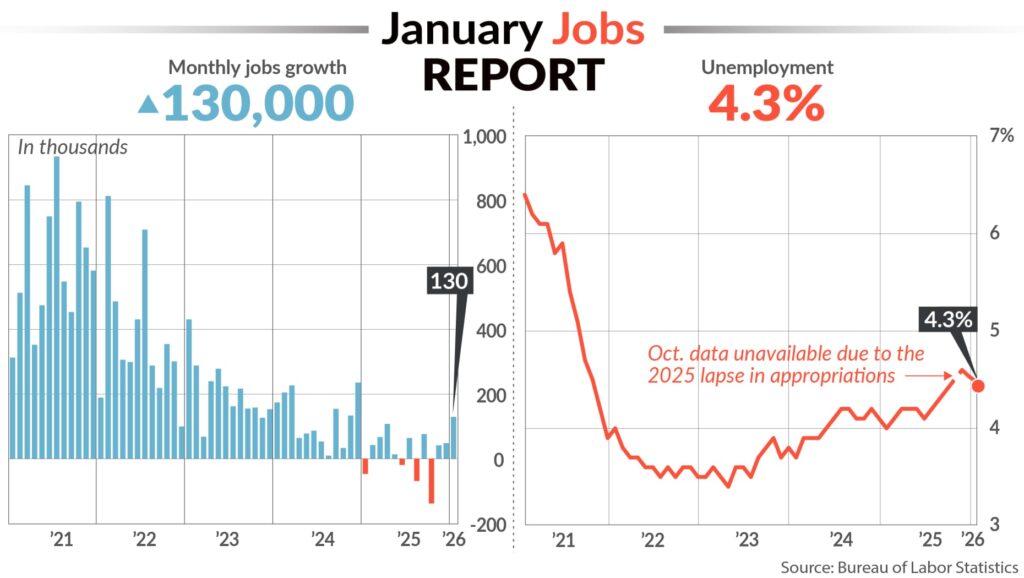
The U.S. labor market showed encouraging signs of improvement in January 2026, according to the Bureau of Labor Statistics (BLS) employment report released on February 11, 2026 (delayed by a brief government shutdown). Employers added 130,000 nonfarm payroll jobs, beating economist expectations of around 70,000–80,000 and marking the strongest monthly gain in several months.
The unemployment rate edged down to 4.3% from 4.4% the prior month, with the number of unemployed people holding steady at about 7.4 million.
Key Statistics
- Wage growth: Average hourly earnings for private nonfarm employees rose 0.4% in January to $37.17, bringing the year-over-year increase to 3.7% — a steady but not accelerating pace.
- Private payrolls: Grew more robustly at around +172,000 (per some reports), while government employment dragged the headline number lower.
Sector Breakdown
Job gains remained concentrated in a few resilient areas:
- Health care — +82,000 (led by ambulatory services, hospitals, and nursing facilities; this sector has been a consistent driver).
- Social assistance — +42,000 (mostly individual and family services).
- Construction — +33,000 (boosted by nonresidential specialty trade contractors).
Losses occurred in:
- Federal government → -34,000 (continuing a trend of declines linked to prior-year policy changes and buyouts).
- Financial activities → -22,000.
Most other major sectors (manufacturing, retail, professional services, leisure & hospitality) showed little change.
Revisions and 2025 Context
The report included significant annual benchmark revisions, which painted a weaker picture of 2025 overall:
- Total nonfarm employment growth for 2025 was revised sharply downward to just +181,000 (from a previous estimate of +584,000).
- Average monthly gain in 2025: only about +15,000
- December 2025 was revised to +48,000 (from +50,000), and November also saw a small downward adjustment.
This suggests 2025 was a notably soft year for hiring, likely influenced by trade tensions, immigration policies, and federal workforce reductions.
What It Means
The January rebound offers a more optimistic start to 2026 after a year of sluggish growth. Health care and construction continue to anchor the labor market, while federal cutbacks and financial sector weakness highlight areas of contraction.
Wage growth remains moderate at 3.7% annually, which should ease inflation concerns and give the Federal Reserve room to maintain its current policy stance. Long-term unemployment ticked up slightly year-over-year, and labor force participation was stable at 62.5%.
Overall, this report signals the labor market may be emerging from a period of weakness — though it’s still far from the robust gains seen in earlier post-pandemic years. Economists will watch the coming months closely to see if this momentum sustains.