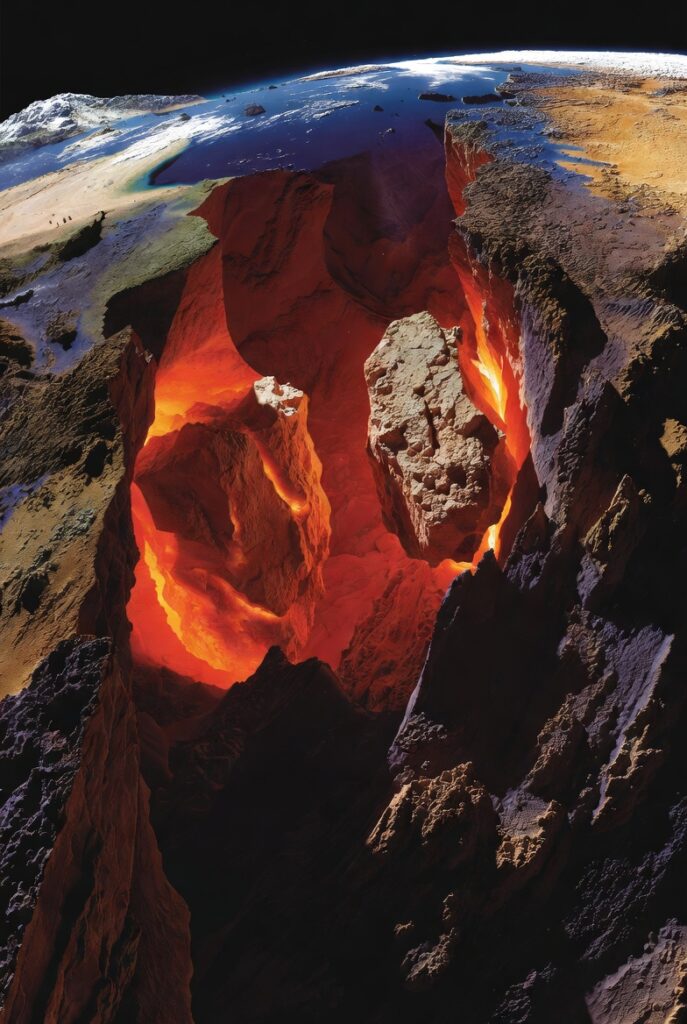
Deep beneath our feet, in a realm completely inaccessible to direct exploration, scientists have uncovered evidence of two enormous, ultra-hot rock structures that have been quietly influencing Earth’s magnetic field for hundreds of millions of years.
Published in February 2026 in Nature Geoscience, a new study led by researchers at the University of Liverpool reveals that these continent-sized formations — often called “blobs” or large low-shear-velocity provinces (LLSVPs) — sit at the base of Earth’s mantle, roughly 2,900 km (about 1,800 miles) below the surface.
One lies beneath much of Africa, while the other is positioned under the Pacific Ocean.
These structures consist of solid but superheated rock that is significantly hotter than the surrounding mantle material. They are encircled by a ring of relatively cooler rock stretching from pole to pole, creating dramatic thermal contrasts at the core-mantle boundary.
Why Do They Matter?
Earth’s magnetic field — the invisible shield that protects life from harmful solar radiation and cosmic rays — is generated by the vigorous movement of liquid iron in the outer core. For decades, scientists assumed this dynamo process was mostly independent of what happens in the mantle above.
The new research challenges that view.
By combining ancient magnetic field records preserved in rocks with computer simulations of core flow, the team found clear evidence that these hot mantle blobs influence how heat escapes from the core:
- Beneath the hot blobs → heat transfer is reduced → liquid iron flows more sluggishly or stagnates.
- In surrounding cooler regions → heat escapes more efficiently → stronger convective currents form.
This asymmetric heat flow creates long-lasting longitudinal patterns in the magnetic field — variations in strength and behavior that differ around the globe and have persisted for at least 200–265 million years.
Key Takeaways from the Discovery
- The two structures are ancient and stable on geological timescales.
- They likely act as thermal anchors, helping control where mantle plumes rise and possibly even influencing the breakup and movement of supercontinents.
- Without these mantle features guiding heat extraction, the geodynamo might behave very differently — potentially making Earth “magnetically weaker” in certain periods or regions.
- The African blob may contribute to phenomena such as the South Atlantic Anomaly, a weak spot in today’s magnetic field.
Final Thought
We often think of Earth’s magnetic field as a product solely of the churning metallic core. This breakthrough reminds us that our planet is a deeply interconnected system: structures hidden thousands of kilometers down can leave their fingerprint on the protective shield we rely on every day.
What other surprises are still waiting in the deep Earth? As modeling and paleomagnetic techniques improve, we’re only beginning to decode the conversation between the core, mantle, and surface that has shaped our world for billions of years.
(Sources: University of Liverpool, Nature Geoscience 2026, Phys.org, ScienceDaily, and related coverage)