

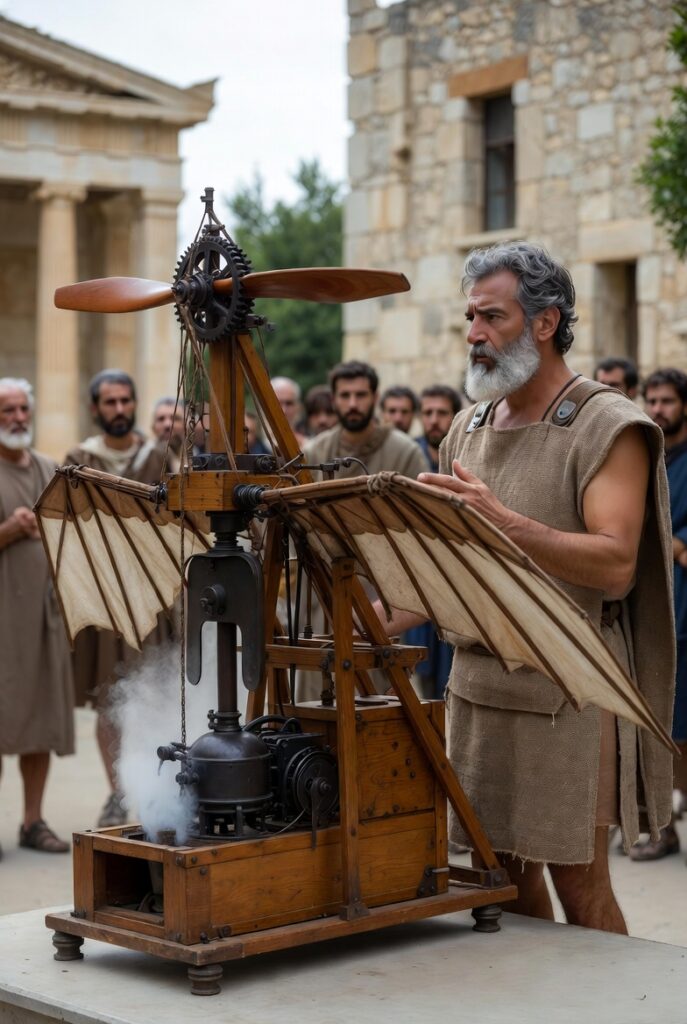
The article highlights Archytas of Tarentum (4th century BC, around 400–350 BCE), an ancient Greek philosopher, mathematician, Pythagorean, statesman, and general from the city of Tarentum (modern southern Italy). He was a highly respected figure who solved difficult mathematical problems (like doubling the cube) and applied math to real-world inventions.
His most famous creation was a wooden mechanical pigeon — often called the world’s first flying machine or an early ancestor of drones, engines, and robots. According to ancient sources (mainly the Roman writer Aulus Gellius), this wooden bird actually flew, propelled by a jet of steam (or in some accounts, compressed air “hidden and enclosed within it”).
The device demonstrated Archytas’ belief that mathematics and scientific principles could make inanimate objects move in ways that mimicked nature’s “miracles.” It is portrayed as a groundbreaking proof-of-concept in mechanics and automation — possibly flying a short distance (some sources outside the article mention around 200 meters) — rather than a practical everyday device.
A modern reconstruction of this steam-powered wooden pigeon is displayed at the Kotsanas Museum of Ancient Greek Technology in Athens.
The article frames the invention as an astonishing technological achievement made ~2,400 years ago, showing the ancient Greeks were already experimenting with self-propelled flight long before Leonardo da Vinci or modern aviation. It emphasizes Archytas as a pioneer who bridged pure theory and practical engineering.
(Note: While popular accounts call it a “drone” or “steam-powered robot,” scholarly interpretations vary — some see it as a true reaction-propelled device, others as a balanced gliding model using compressed air, and a few question how far or how autonomously it really flew.)